
How to Build a Successful Muslim Home
My neighbor asked me a question I was not ready for.
We had lived next door for three years. She had watched our family. She had seen our children come and go. She had heard the call to prayer through the wall. She had watched Ramadan arrive and change the rhythm of our household. She had been invited to Eid celebrations.
One afternoon she knocked on the door and said: "I want to ask you something and I hope you don't mind."
I said I didn't mind.
She said: "How do you build that? What you have in your home. The way your children are. The way your husband and you treat each other. The way it all fits together. How did you build it?"
I stood in the doorway and thought about what to say.
The honest answer was: slowly. One decision at a time. Over years. With books that helped and conversations that cost something and mistakes that required repair. With a specific intention that we had named to each other early in our marriage and returned to when we lost sight of it.
But the deeper honest answer was: we did not build it alone. We followed a plan that was better than anything we could have designed ourselves. A plan from the Quran and the Sunnah, translated into practical form by scholars who had spent their lives understanding what the Islamic home is supposed to be.
This article is that plan. Not a perfect execution of it. A faithful description of what it contains, why each element matters, and how a Muslim couple can begin building it today, from wherever they are.
What Makes a Muslim Home Successful
Before the how, the what.
A happy Muslim household is not a household without trouble. It is not a household where the kids don’t have problems or where the marriage partners always agree or where there’s no financial stress. These ideas of happiness are based on illusions that no household can maintain.
A good Muslim family is the one which produces what it is supposed to produce: Muslims who know Allah, love the Prophet ﷺ, have the manners that Islam expects from them, and who go out into the world without losing their Islamic identity.
The Prophet ﷺ said: "Allah is pleased with three things for you: that you worship Him and not associate anything with Him, that you hold firmly to the rope of Allah all together and not become divided, and that you give sincere advice to those whom Allah has put in authority over you." (Sahih Muslim)
A Muslim home succeeds when it is a place where this pleasing of Allah is the organizing principle. When the decision-making process that takes place every day, whether big or small, is done according to the desires of Allah. When the culture of the home revolves around worship, cohesion, and advice, not prestige, fun, or comfort.
That standard is not oppressive. It is liberating. A home organized around Allah's pleasure has a clear direction. Every decision has a reference point. Every difficulty has a framework. Every success has a proper place.
Foundation Stage: The Intention That Precedes Everything
The first stage of building a successful Muslim home is not a purchase or a practice. It is a conversation.
A Muslim couple needs to explicitly name, to each other, what kind of home they want to build. Not as a vague aspiration but as a concrete, shared intention. What do we want our home to be known for? What do we want our children to carry from this house into their adult lives? What does success look like for us in ten years, and in twenty?
It is not easy for everyone to have this discussion. It demands an understanding of the truth of the present situation, knowing where you want to go, and humbly accepting what is not there yet.
But the couples who have this conversation and return to it regularly are building differently from the couples who have never named the intention. Because intention shapes attention. When a couple knows what they are building toward, they notice when they are building away from it. They can correct. They can recalibrate.
The Islamic tradition understands this. Every significant act in Islam begins with niyyah, intention. The Prophet ﷺ said: "Actions are by their intentions, and every person will have what they intended." (Agreed upon) Building an Islamic home is an action. It begins with intention.
"Blissful Marriage: A Practical Islamic Guide" by Drs. Ekram and Mohamed Rida Beshir, available at Madinah Media, guides couples through exactly this foundational work. The Beshirs have counseled hundreds of Muslim families and have distilled what makes a Muslim marriage the launching point of a successful Islamic home rather than an obstacle to it. The book addresses the shared intention that a couple needs to set before specific practices can be built on top of it.
Ustadha Rania, who facilitates a pre-marital and early marriage program for Muslim couples, described what she has watched happen when couples engage seriously with this foundational work: "The couples who succeed are not the ones who have the fewest problems. They are the ones who have a shared language for addressing problems. They know what they are building toward. They can name it. And when something goes wrong, they have a reference point: does this bring us closer to that, or further from it? That reference point is what separates couples who grow through difficulty from couples who are broken by it."
Building Stage One: The Atmosphere of the Home
A home's atmosphere is the invisible environment in which its residents live. Children are forming their understanding of the world inside that atmosphere before they are old enough to name what they are absorbing.
The Islamic environment in the house is formed through daily acts which, although not spectacular on their own, are quite formative.
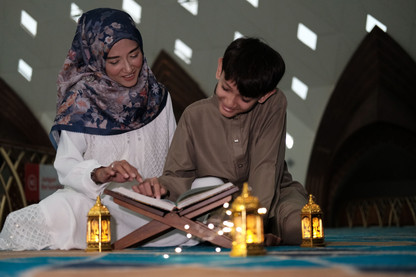
The Quran in the home. Not displayed. Recited. Parents reading their daily portion. Children hearing the Quran from the earliest age as the normal sound of the household morning. The Prophet ﷺ said the house where Surah Al-Baqarah is recited is one from which shaytan flees. The mechanism of that protection is the long-term formation of the people inside it, shaped by regular Quranic presence into people who carry that formation with them.
Salah prayed in its times. The single most powerful structural practice a Muslim home can establish is the five prayers at their times, every day, with the household organizing around the prayer rather than the prayer organizing around the household's other commitments. When the adhan sounds and the family pauses, the home is making a statement about what it is organized around. That statement is repeated five times every day. Over years, it shapes everything.
The adhkar of morning and evening. The du'a before eating, before sleeping, before leaving the home. These phrases, repeated daily, become the nervous system of the Islamic home. They are the moments when the name of Allah enters the ordinary flow of the day. A home where Allah is named regularly in the ordinary hours is a home where His presence is felt in those hours.
"The Muslim Home: 40 Recommendations" by Sheikh Muhammad Salih Al-Munajjid, available at Madinah Media, provides forty specific, actionable practices for building exactly this atmosphere. It is organized by category and grounded entirely in the Quran and Sunnah. For a couple in the early years of building their home's Islamic culture, working through these forty recommendations over the course of a year, implementing a few at a time, produces a transformation that no single sweeping change can produce.
Building Stage Two: Raising the Children Within It
Children do not arrive into an Islamic home. They are formed by one.
The Muslim home does not raise Islamic children by teaching them Islam. It raises Islamic children by being Islamic, consistently and visibly, across the years of the child's formation. The parents who are the home are the curriculum.
A child who grows up watching their father prioritize the prayer over the screen, their mother choose honesty over social ease, both parents speak about Allah in the ordinary moments of the day, both parents hold each other with respect and tenderness even in difficulty, is a child who is receiving an Islamic formation that no classroom can replicate.
This does not mean parents need to be perfect. It means they need to be genuine. A parent who fails and then makes istighfar is teaching their child something valuable: that the response to failure in Islam is not shame and hiding but acknowledgment and return. A parent who disagrees with their spouse and then resolves the disagreement with adab is teaching their child how conflict is managed within an Islamic framework. The imperfect parent who is genuinely trying is a more powerful Islamic educator than the parent who projects perfection they do not have.
"Meeting the Challenge of Parenting in the West: An Islamic Perspective" by Drs. Ekram and Mohamed Rida Beshir addresses the specific challenges that Muslim parents face when raising children in a non-Muslim-majority environment. It provides an Islamic framework for building children's identity, handling the tension between Islamic values and cultural pressures, and maintaining the home as an Islamic environment even when the world outside it is pulling in other directions.
Available at Madinah Media.
The specific challenge of raising Muslim children in Western contexts is the challenge of identity. Children need to know who they are, why they are, and what their identity means before the world outside begins asking them to be something else. The home that builds this identity clearly and confidently, through daily practice and deliberate conversation, gives children a resource for the adolescent years that cannot be provided later on an emergency basis.
"Muslim Teens: Today's Worry or Tomorrow's Hope?" by the Beshirs addresses this directly, providing Muslim parents with an Islamic understanding of adolescent development and specific tools for maintaining connection, communicating effectively, and supporting Islamic identity through the most challenging years of a child's formation.
Available at Madinah Media.
Building Stage Three: The Relationship Between the Spouses
The quality of the marriage at the center of the home determines the quality of the home that is built around it.
This is not a romantic observation. It is a structural one. Children absorb the relationship between their parents with a thoroughness and a retention that no explicit teaching matches. The way a father speaks to their mother, the way a mother speaks to their father, the way they resolve conflict, the way they show kindness, the way they support each other's practice: all of this becomes the child's template for what relationships look like, what marriage looks like, and what a Muslim home looks like from the inside.
The Prophet ﷺ modeled the marriage relationship with specific, documented care. He helped with household work. He was gentle with his wives. He expressed affection explicitly. He took interest in what they cared about. He consulted them. He said: "The best of you is the one who is best to his family." The domestic relationship was not peripheral to his character. It was one of its clearest expressions.
"Justice and Beauty in Muslim Marriage: Toward Egalitarian Ethics and Practice" available at Madinah Media explores how the Quranic principles of justice and beauty apply within the marriage relationship, addressing both the rights of each spouse and the practices that build the kind of partnership from which a genuinely successful Islamic home can grow.
For couples who find themselves in difficulty within the marriage, the home cannot be successfully built around a broken or neglected relationship at its center. The investment in the marriage is not separate from the investment in the home. It is the same investment.
Building Stage Four: The Knowledge That Sustains It
A Muslim home cannot remain healthy on spiritual momentum alone. It requires ongoing Islamic knowledge to sustain and deepen what has been built.
The Islamic tradition is not a fixed deposit that can be accessed once and relied upon indefinitely. It is a living engagement. A family whose Islamic knowledge stopped growing at some point will find that the home that was built on that knowledge begins to show its age. Questions arise that the existing framework cannot answer. Challenges arrive that the existing formation has not prepared for. The world changes in ways that require Islamic thinking to respond to.
Ongoing engagement with Islamic knowledge is not a luxury for the spiritually advanced. It is maintenance. The Islamic home requires it as regularly as any physical structure requires the attention that keeps it sound.
This means books read and discussed. It means an Islamic library that grows over time. It means parents who are themselves students of their religion, not only instructors of it to their children. It means seeking out scholars, lectures, and resources that continue to deepen the family's Islamic formation.
Madinah Media's full catalog serves this ongoing need. From Seerah resources that bring the Prophet's ﷺ example closer to the family's daily life, to hadith collections and commentaries that deepen engagement with the Sunnah, to parenting and family books that address the specific challenges of each stage, the catalog grows alongside the family that engages it.
The Madinah Media collection covers Islamic studies for every member of the family and every stage of the family's lifecycle, from children's Islamic coloring books and Seerah stories to adult aqeedah, hadith, fiqh, and family resources. Building an Islamic library from this catalog gives a family access to Islamic knowledge that is both authentic and practically organized.
The Long View: What Success Actually Looks Like Over Time
My neighbor asked how we built what we had. The answer I gave her in the doorway was incomplete. Here is the rest of it.
We built it by failing regularly and returning consistently. By having the intention without always meeting it. By reading books that showed us what was possible and then practicing toward that possibility with imperfect but genuine effort.
We built it by making the Quran present even in the years when our own relationship with it was weak. By praying together even in the seasons when the prayer was mechanical rather than alive. By speaking of Allah to our children even before we had fully articulated our own relationship with Him. By treating each other, in front of the children, with the care we wanted them to grow up believing was normal.
We built it in the ordinary Tuesday afternoons when nothing was dramatic and the only Islamic choice available was a small one, made correctly, without an audience.
The successful Muslim home is not built in its extraordinary moments. It is built in its ordinary ones. In the accumulated weight of thousands of small choices, made consistently over years, in the direction of what Allah has asked for.
That is the building method. It is not glamorous. It is not fast. It does not produce visible results in the first month or the first year.
But it produces what my neighbor noticed from next door. A home organized around something she could not see but could feel. A home that had, over years, become exactly what it was built to be.
Bismillah. Begin with the first brick.