
Arabic Grammar Curriculum: Plan From the First Lesson to Classical Texts
Omar is a homeschooling father with a good heart and a full bookshelf.
Every few months he adds another Arabic book. A workbook here. A grammar primer there. A reader someone recommended at the masjid. His shelf looks impressive.
His children's grammar does not.
When I asked what they were studying, Omar laughed. "A bit of everything," he said. "That is the problem."
He did not have a curriculum. He had a pile.
An assortment of good books is not a program. A curriculum is a process with a starting point, a destination, consistent practice, regular review, and distinct milestones. Without these elements, even the best of books yield fragmented learning.
In this article, you will learn how to create a genuine curriculum for Arabic grammar. This has been informed by the Arabic Grammar and Arabic Curriculum sections found at Madinah Media. I have used these materials in the course of reviewing this article. And it is written from a Sunni perspective in which grammar is subservient to the Qur'an and the Sunnah.
The Importance of the Plan: The Purpose of the Grammar
"Verily, this is a clear Arabic Quran." (Ash-Shu'ara 26:195)
And also:
"We have indeed made it a Quran in Arabic, full of blessings, that you may understand." (Az-Zukhruf 43:3)
Understanding is the goal.
The scholars of the Sunni tradition built Arabic grammar for this reason. They wanted every reader of the Qur'an and the hadith to read correctly and understand deeply. The great grammar texts were written by scholars who loved the revelation and wanted to guard it.
So when you design a grammar curriculum, keep the purpose in front of you. You are not teaching grammar for its own sake. You are building a student who can read Allah's words and the words of His Messenger with comprehension.
That purpose shapes every choice below.
Dr. Ahmed told me: "A grammar curriculum without the Qur'an at its center becomes a dry subject. A grammar curriculum anchored in the Qur'an becomes an act of devotion. Students feel the difference within weeks."
What a Curriculum Actually Contains
Five ingredients make a curriculum.
- Scope. What will be taught? Which topics, and which are left for later?
- Sequence. In what order? Each step should prepare the next.
- Practice. How will students apply each idea? Exercises, reading, writing, speaking.
- Review. How will earlier lessons return so they are not forgotten?
- Assessment. How will you know the student has really learned it?
Most families have some scope and some practice. Few have sequence, review, and assessment. These are the pieces needed to make an unordered pile of books into a lesson plan.
Five Strands of a Comprehensive Grammar Curriculum
Grammar in Arabic isn’t just about rules. A comprehensive curriculum includes five strands.
Strand 1: Reading Mechanics
Letters, short vowels, long vowels, tanwin, sukun, shaddah. If you lack this, everything falls apart. Examples in grammar lessons will be in Arabic. The student will not be able to concentrate on the rule if he or she cannot read the words.
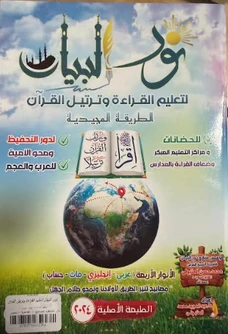
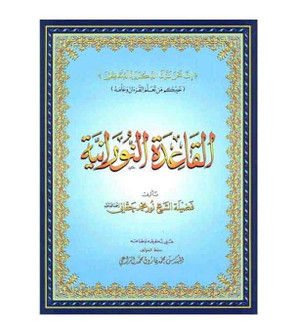
Madinah Media includes Al-Qaidah An-Noraniah, Learn to Read Arabic Letters, and My Arabic Letters Book, as well as one recently published Arabic Up Close: Introduction to Arabic Sounds and Script, which they call a basic tool for beginners.
Strand 2: Nahw (Syntax)
How words work together in a sentence. The three categories of words. Nominal and verbal sentences. The three cases and their endings. Possession. Prepositions. The particles that change what follows them.
Strand 3: Sarf (Morphology)
How words are built. Roots. Patterns. Verb forms. Singular, dual, and plural. This strand makes vocabulary grow fast, because one root unlocks many words.
Strand 4: Application Reading
Grammar must meet real text. Short passages. Familiar surahs. Selected hadith. Simple stories. This is where theory becomes skill.
Strand 5: Writing and Expression
Dictation, short sentences, composition. Students learn how to look for endings and spelling when writing something which they would not do through mere reading. Madinah Media offers Arabic Writing Workbooks, Assistant in Spelling Dictation series, a Composition and Writing Assistant category, and a Write and Express category.
The curriculum must incorporate all five strands weekly but one strand more than the others.
Choosing a Spine
Every curriculum requires a spine. The spine will be the series that gives the curriculum order. Other books enhance the spine.
You can choose between two general categories.
Option A: An Integrated Course as the Spine
Grammar is introduced through reading, vocabulary, and conversation in an integrated course. Madinah Media has several integrated courses.
- Noor Al-Arabiyyah runs from Pre-KG through Grade 6. It is a graded program for non-native learners with clear levels.
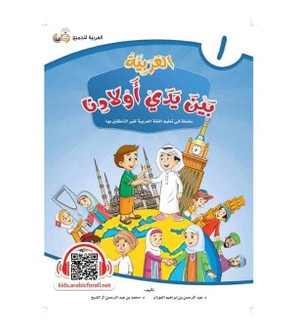
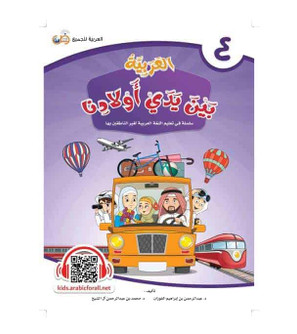
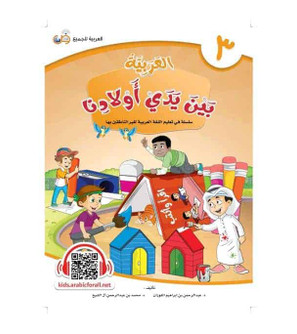
- Arabic Between Our Children's Hands is a five-level student book series for elementary learners, by Dr. Abdul Rahman Al-Fuzan and Dr. Muhammad Abdul Rahman Al Sheikh.
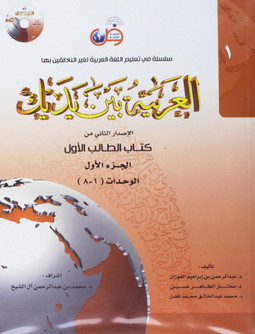
- Arabic Between Your Hands is from the Arabic for All course that caters to adult students.
- Madinah Arabic Reader is a book written by Dr. V. Abdur Rahim using the same teaching approach as that of the Islamic University of Madinah and includes English explanations for English speakers.
The list of courses on Madinah Media's Arabic Curriculum page includes the following: Al Asas, Arabic Without Tears, Bidaya, and At-Takallam. I have not reviewed them myself, so you will have to verify that they fit your child's skill level.
Option B: A Grammar Series as the Backbone
Here, a separate grammar series sets the nahw sequence. Reading and vocabulary come from other sources.
- Grammar Step by Step (النحو خطوة بخطوة) is a series of six books, with exercise booklets that accompany the textbooks. The descriptions say each book builds on the one before. Book Six is called the final level.
- Grammar Level One, Two, and Three (قواعد النحو) are shorter level books.
- Clear Grammar for the Elementary Stage (النحو الواضح) follows the classic method of Ali Al-Jarim and Mustafa Amin, which gives many examples before the rule.
Pick one spine. Do not mix two spines at the same stage. Two sequences will collide, and your student will meet topics out of order.
Zaynab shared: "I used to switch series whenever my daughter felt stuck. She was always starting over. When I finally committed to one spine for a full year, her progress was obvious. The series was never the problem. My switching was."
A Sample Scope and Sequence for Children
The following is a sample that would be suitable for a child who is just beginning at the zero level. Adjust according to your child's age and progress.
- Level 0: Reading (Weeks 1 - 8): Alphabets, vowels, and basic words. Use reading primer. This is a stage where one should be able to read vowelled text fluently.
- Level 1: First Grammar (Grade 1): Words, Nouns and Verbs, and simple sentences. Use Level 1 onwards of your selected spine. Reading is done using simple phrases from the Qur'an.
- Level 2: Core Nahw (Grades 2-3). Nominal sentences, verbal sentences, cases, possession, prepositions. Within the series, this is the middle of the book series. Exercise booklets can be used for regular practice.
- Level 3: Expansion (Grades 4-5). Pronouns, number agreement, gender agreement, more verb forms, particles. Include dictation and composition practice.
- Stage 4: Consolidation (Year 6). Review everything. Parse sentences fully. Read longer passages. Use the final levels of your spine.
At the end of this program, a student will have the ability to analyze short verses of the Qur'an to understand the functions of individual words within them.
Sample Program for Older Teens/Adults
Older students can go through stages quicker, as they bring to class more experience in reading and thinking on abstract level. But older students have fewer hours available for studying, and this program must consider that fact.
- Stage 1: Reading and Basics (1-2 months). Correct letter and tashkil errors, if any.
- Stage 2: Systematic beginners' course (9-12 months). The Madinah Arabic Reader is recommended especially for native English speakers. Try out "Arabic Between Your Hands" to gain more experience in the language.
- Stage 3: Grammar consolidation (6-12 months). Use specialized nahw book with exercises. Apply rules to the Qur'an daily.
- Phase 4: Intermediate classical text (1 to 2 years). Madinah Media carries an explanation of Qatr al-Nada wa Ball al-Sada by Ibn Hisham al-Ansari, described as a classic intermediate text on grammar and morphology. This is the traditional bridge.
- Phase 5: Advanced study. Madinah Media also lists Ibn Malik's Alfiyyah on grammar and morphology. Study it with a teacher and a commentary.
Notice what is missing. There is no shortcut from a children's workbook to the Alfiyyah. The path has steps. Honor them.
The Weekly Rhythm
Consistency beats intensity. Here is a simple weekly cycle you can adapt.
- Day 1: New lesson. Introduce one grammar idea from your spine. Read the examples first. Then the rule.
- Day 2: Practice. Complete the exercises or the exercise booklet pages.
- Day 3: Application. Find the new idea in a verse, a hadith, or a reading passage. Mark it.
- Day 4: Writing. Dictation or a few sentences using the new idea.
- Day 5: Review. Go over the week. Quiz orally. Correct errors.
Twenty to thirty minutes a day is enough for most students. Keep it short and steady.
Fatima shared: "We used to do one long grammar session on Saturday. My son dreaded it. When we moved to twenty minutes every day, the dread disappeared. The grammar stayed with him because he met it often."
Tools That Support the Curriculum
A good curriculum has supporting tools. Madinah Media's listings include several.
- Atlas for Arabic Grammar (أطلس النحو العربي). By Abbas Manasra. The description compares it to a geographic atlas. A world map first shows the whole picture, then you zoom into details. This book gives the whole map of grammar first. It is excellent for review and for visual learners.
- Arabic Reading Lessons. A collection of reading passages, ancient and modern, in six sections. Use it for Strand 4.
- Dictionaries. Madinah Media has Arabic dictionary, English-Arabic dictionary, and picture dictionary sections. Students should use a dictionary from the start.
- Writing workbooks. For Strand 5, use the writing and dictation series.
- Qur'an and hadith. The best application text is always the Book of Allah and the words of His Messenger. Use a Mushaf alongside every lesson.
- A caution about colloquial books. The grammar category also lists Masrawy, a book for Egyptian colloquial Arabic. It is useful for its purpose, but dialect is not the language of the Qur'an. Keep it separate from your grammar curriculum.
Assessment: How to Know They Learned It
Assessment is not about stress. It is about honest feedback.
Use simple checkpoints.
- Monthly oral check. Ask your student to explain one grammar idea aloud, with an example from the Qur'an.
- Termly parsing task. Give a short verse. Ask them to identify the sentence type, the main words, and the endings.
- Dictation. Read a short sentence. They write it with correct endings.
- Portfolio. Keep a folder of their best work each term. Looking back shows real growth.
- The retake rule. If a student struggles with a checkpoint, do not move on. Repeat the section. Mastery matters more than speed.
Ahmed told me: "The best thing I did was add a termly parsing task. It showed me exactly where my students were weak. Before that, I assumed they understood because they finished the pages. Finishing pages is not the same as learning."
For Schools, Cooperatives, and Weekend Programs
If you manage a group, you need a scalable curriculum.
Get a spine that works throughout the entire program. Teach all teachers using the same series. Develop a shared scope and sequence to know what should be taught in each session.
Standardize your benchmarks as well. With every teacher following the same benchmark, you will be able to identify struggling students early on.
Common Curriculum Mistakes
- Having no sequence. Random books produce random knowledge.
- Switching spines too often. Commit for at least a year.
- Skipping reading mechanics. Weak reading undermines everything.
- Never reviewing. Without review, last month's lesson disappears.
- Memorizing rules without application. Always connect grammar to real text.
- Racing to classical texts. Respect the stages.
- Forgetting the purpose. If grammar loses its link to the Qur'an, motivation fades.
Conclusion: From a Pile to a Path
Omar did not need more books. He needed a plan.
We sat down together and mapped it. One spine. A weekly rhythm. A few supporting tools. Simple checkpoints. A clear view of where the road leads.
Within a term, his children were calmer and more confident. They knew what came next. They could feel themselves moving forward.
That is what a curriculum gives you. It does not make Arabic easy. It makes the path visible.
Build yours around the Qur'an. Choose one spine. Cover the five strands. Practice daily. Review often. Assess honestly. Move forward step by step.
Madinah Media's Arabic Grammar and Arabic Curriculum sections hold the materials for every stage, from first letters to the classical texts. Take them off the pile and put them on a path.
Bismillah. Draw your map today.