
Islamic Kindergarten Curriculum: What Your Child Actually Needs at Five
A mother at a homeschool co-op once dumped three Islamic studies books on the table in front of me. Her daughter was starting kindergarten that fall. She’d ordered samples, read every description she could find, and asked in three different Muslim parent forums. And she was still stuck.
“They all say age-appropriate. They all say comprehensive. They feel nothing alike and I have no idea which one is right for a five-year-old.”
She slid them over. “So what’s the actual difference?”
Fair question. I went through them one by one.
The first was a workbook. Coloring pages, matching games, a few Islamic phrases. Cute. But there was hardly any content in it, just fine motor practice with an Islamic sticker on top.
The second was a proper textbook, with reading passages, vocabulary lists, and comprehension questions. The vocabulary list had “monotheism” on it. And “revelation.” For a five-year-old who still can’t tie her shoes.
The third was built around stories. Every section ended with a Quranic verse, there was recorded audio, and the activities were things a kindergartner would actually sit still for.
“This one,” I said.
“Why?”
“Because it knows who it’s teaching.”
That’s honestly the whole article. The right curriculum isn’t the one with the most pages or the loudest description. It’s the one that gets what a five-year-old can take in, and gives it to her in a way that sticks.
What Kindergarten Actually Is: A Developmental Reality Check
It’s not first grade with a smaller desk. Kindergarten sits in the gap between playing and formal school, and these kids are only just starting to build the focus that real learning needs.
A five-year-old can usually pay attention for fifteen to twenty minutes. After that they need a break, or something different to do. They’re slowly moving from concrete thinking toward abstract thinking, but they still need something they can see or touch for every big idea. Stories, pictures, songs, repetition, and moving around work. A long explanation doesn’t. Neither does a definition.
I don’t see that as a limitation. It’s just how five-year-olds are, and a good curriculum starts from there.
Hand a five-year-old a textbook meant for older kids and you’ll get one of two results. Either she gets confused and pushes back, because it doesn’t fit where she is. Or she learns to say the right answers without understanding any of them. Both are bad, and for the same reason: she starts to feel that Islamic learning is something she’s failing at, before the real learning has even started.
The good version looks different. By the end of the year she knows a handful of things well. Islam feels warm and familiar to her. She links learning about Allah and the Prophet ﷺ with good stories and good feelings. That’s a kid who keeps going.
And I’d say warmth comes first, not knowledge. Knowledge needs somewhere to land.
The four things a complete curriculum covers
There are four areas, and they should talk to each other. If they sit in four separate piles, you’ve missed the point.
- Islamic studies is what we believe, how we pray, the story of the Prophet ﷺ, and basic manners. For this age that means stories, short and concrete explanations, a Quranic verse for each theme, and activities where the child gets to show what she took in.
- Quran is really two jobs at once. She starts recognizing Arabic letters and their sounds, and she learns specific surahs with their meanings. Teach them together. Memorizing a surah without the meaning just gives you a string of sounds. Learn the meaning with it and it becomes hers.
- Arabic matters most if your child doesn’t hear it at home. Young children pick up language faster than they ever will again. If she starts on letters, sounds, and simple words at five, she’s using a window that gets a lot smaller around age eight.
- Character is the odd one, because it isn’t really a subject. It’s inside everything else. Each Islamic studies unit teaches a quality, each surah has a moral side, and each Arabic phrase carries meaning. A curriculum that gives character its own separate chapter has kind of missed it. Character is how all the rest shows up in her day.
Noor Al-Islam, kindergarten levels
KG-1 has five units: “I Love My Lord,” “Let’s Make Wudu,” “When the Prophet Was Born,” “Family Gathering,” and “The Prophet Loves Us.” They were designed for young children, both in age and in how they think.
Look at the titles again. They’re warm before they’re instructional. “I Love My Lord” is a relationship before it’s a theology lesson. “The Prophet Loves Us” is a feeling before it’s a fact about his life. When a child loves a subject first, she studies it differently.
KG-1 introduces Allah, the Prophet ﷺ, basic wudu, and family values. Each section ends with a Quranic verse from the well-known surahs, explained in plain language, with audio. She doesn’t only hear the verse. She hears what it means and why it matters.
KG-2 has five more units: “The Pillars of Islam,” “I Respect the Elderly,” “I Perform Wudu’ to Pray,” “The Five Daily Prayers,” and “The Prophet Taught Me.” Every unit ends with a verse, an explanation, exercises, and audio.
Here it goes deeper. The pillars don’t arrive as a list to memorize. They’re tied to practice. Wudu leads to prayer, prayer is a pillar, and the Prophet ﷺ taught us how to pray. A five or six-year-old ends up seeing how it fits together instead of holding a pile of loose facts.
The KG-2 surahs are Al-Qadr, At-Tin, Az-Zalzalah, and Al-Masad. Each has its meaning explained in words a kindergartner can follow, and the audio means she can hear the correct recitation as many times as she needs before she tries it herself.
You can get it at Madinah Media.
Zaynab homeschools two kids and used Noor Al-Islam from KG with both of them. This is how she described the difference: “What I noticed first was that my daughter was never confused. She was five and she understood every lesson. Not because it was dumbed down. Because it was built for her. The stories were the right length. The explanations used words she knew. The activities were things she actually wanted to do. By the end of KG-2 she knew the five pillars and how they connect to practice, she knew basic wudu, and she’d memorized three or four surahs with their meanings. And she still wanted to keep going.”
IQRA, if you want more structure
Some families want something closer to a classroom. For them, Madinah Media also has the IQRA Kindergarten Curriculum.
It’s four volumes: Islamic History, Seerah of the Prophet ﷺ, Quranic Studies, and Fiqh and ‘Ibadat. Each has clear objectives, suggested activities, behavioral objectives, and lesson plans that take the teacher through every session.
The volumes work together or on their own, so you set the pace. Want to spend a season on Seerah, then move to Fiqh? Go ahead. Teaching in a school with strict lesson plan requirements? IQRA will slot into a formal schedule more easily than most.
It’s been used in Islamic schools for decades, which tells you something. The lesson plans are specific enough to actually use, and the behavioral objectives give a teacher a real way to tell whether a child understood the material.
Also available at Madinah Media.
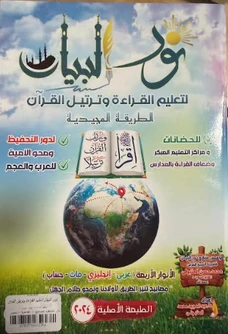
Noor al-quran
Quran learning needs its own curriculum next to Islamic studies. They’re separate things. One teaches a child what Islam is. The other teaches her to read and memorize the Quran. You want both, and neither one covers for the other.
Noor Al-Quran KG-1 covers Surah Al-Asr, Al-Falaq, and An-Nas. KG-2 covers At-Tin, Quraysh, Al-Fil, and Al-Fatiha. Each surah comes with its meaning, its values, letter-reading practice, and review activities. The audio throughout is Shaykh Abdul Basit Abdul Samad.
What I like is that meaning comes with the memorizing from day one. When a kindergartner learns Al-Asr, she learns that “wal-asr” means “by time,” and that the surah is saying something about what we do with it. That understanding keeps the memorization in place. Repetition alone doesn’t.
Madinah Media carries this one too.
Arabic, and the window that closes
This is the one most families put off too long.
Arabic is the language of the Quran. A child who starts at five and sticks with it through elementary school will eventually understand what she says in salah. She reaches the meaning directly instead of through a translation. And that’s much harder to build later.
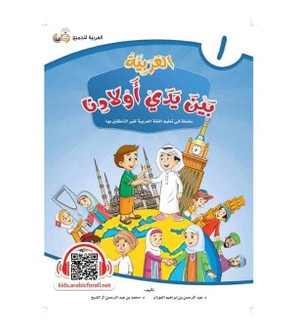
For non-native speakers at this age, there are the Noor Al-Arabiyyah Pre-KG and KG-1 levels from Manarah Publishing, available through Madinah Media. It’s a pioneering series for teaching Arabic as a second language, using modern teaching methods and Arab and Islamic culture to help learners work toward fluency. The early levels cover letters, basic vocabulary, and the foundations of reading.
Put Noor Al-Arabiyyah KG-1 next to Noor Al-Islam and Noor Al-Quran and you get three curricula that feed each other. The Arabic words she learns turn up in the surahs she’s memorizing. The ideas from Noor Al-Islam link back to the vocabulary in Noor Al-Arabiyyah.
That overlap is the difference between a real curriculum and a shelf of random books that all happen to be about Islam.
Habit first, knowledge second
The mother at the co-op was asking the right question the wrong way. She wanted the best book. What she needed was the right combination of books, used every day, at a pace her daughter could keep up.
Fifteen to twenty minutes a day, five days a week, all year. No single big session can match that. It makes Islamic learning an ordinary part of the day, and the habit is worth more than any one lesson.
The Noor Series is built for exactly that. Madinah Media sells it as individual volumes or full bundles. The lessons are short enough, the activities hold a small child’s attention without wearing her out, and the content builds week by week. Used together, the three curricula give you the integrated Islamic kindergarten education that most families are really after when they search for “the best curriculum.”
Months later, someone asked that mother’s daughter what she thought of her Islamic studies. She said, “I love when the Prophet loves us. We have a unit about it.”
She talked about a Noor Al-Islam unit title the way you’d talk about a favorite storybook. That’s how it should feel at five. Not a subject she has to get through. A story she’s already inside.
Bismillah. Build the foundation now.