Arabic Curriculum for Advanced Learners
Take a learner I’ll call Zaynab.
She finished a good beginner series two years ago. She reads vowelled Arabic without trouble and can follow a simple conversation. She felt proud of that, and she had every right to.
Then she opened a page of tafsir in Arabic. No vowels. Long sentences. Words which were unknown to her and a grammar that was only partly known to her. It took her twenty minutes just to read one paragraph and she grasped only half of it.
“I thought I was advanced,” she told me. “I was just past the beginning.”
Almost every serious learner hits this wall. The beginner books end, the advanced books look enormous, and nobody has drawn the road between them. That road is what this article is about. An Advanced Curriculum in Arabic: What It Needs, How to Design It, and Books by Madinah Media for All Sections.
The Meaning of “Advanced”
It doesn’t mean perfection. It means you can deal with authentic texts, even slowly.You’re probably there if:
You read vowelled Arabic fluently, and unvowelled Arabic with some effort.
You know the main grammar categories and can parse most sentences.
You have a few thousand words of vocabulary.
You can write a simple paragraph and follow a short talk.
You want to read the Islamic sources in the language they were written in.
Allah describes the Qur’an as “a clear Arabic tongue” (An-Nahl 16:103). And the Prophet, peace be upon him, said: “May Allah brighten the face of a person who hears something from us and conveys it as he heard it” (reported by Al-Tirmidhi and others). Advanced Arabic is how you take that seriously: you understand the sources properly, and you pass them on faithfully.
Six Threads, One Curriculum
A solid curriculum combines several threads:
A thread of skills: one progression through reading, listening, speaking and writing.
An advanced course in nahw: syntax at the level required for classical texts.
Sarf: morphology, so you can decode words you’ve never met.
Extensive reading: graded texts first, then authentic ones.
Writing: producing Arabic, not only absorbing it.
The Islamic sources: Qur’an, tafsir, hadith and fiqh, read with a teacher.
Once your grammar is solid you can add a seventh, balaghah. It shows you how carefully the Qur’an and hadith are worded.
Dr. Ahmed likes to say an advanced learner needs a spine and ribs. The spine is one main series. The ribs are everything else holding it up.
Strand 1: The Spine
Pick one main series to set your pace. Madinah Media carries two good ones.
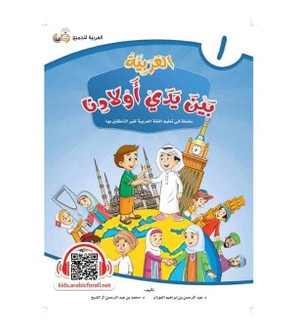
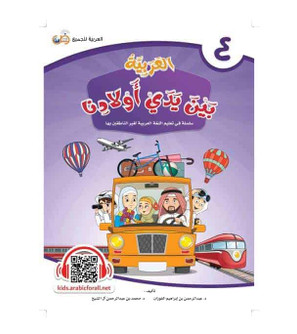
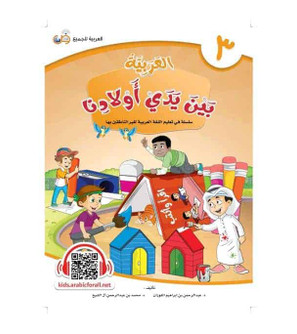
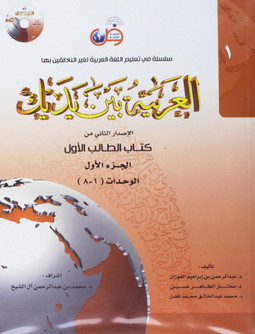
Option A: Arabic Between Your Hands, Levels 3 and 4.
This is from the Arabic for All series. According to Madinah Media, this is a developed form of a previous series written by a group of scholars specialized in teaching Arabic to non-native Arabic speakers.
Level 3 comes in two parts of 8 units each, so 16 units and 112 basic lessons in total, with 7 lessons per unit. Every unit has a comprehension text with exercises, vocabulary and expression, language rules with exercises, listening work, and oral and written expression. The listing also mentions vocabulary lists at the end of the level and digital audio for all the texts and some exercises.
Level 4 has the same shape: two parts, 16 units, 112 lessons. The units are bigger, around 21 pages each. You get comprehension texts, two sets of language rules with exercises, listening, advanced expression, a writing-and-research section, and six pages of comprehensive reading. That last pair is the reason I like this level. Writing and research, plus a lot of reading, is exactly what pushes you past the plateau.
Madinah Media also sells teacher books for both levels, and full sets of student and teacher books. If you study with a tutor, the teacher book makes their job much easier.
Regarding speed: with three lessons per week, it will take 37 weeks to finish one 112 lessons level. With five lessons per week, it will be around 22. The length of a lesson may vary, so think of it as a unit of learning instead.
Option B: Madinah Arabic Reader.
This series is by Dr. V. Abdur Rahim, a former professor of Arabic at the Islamic University of Madinah. According to Madinah Media, it teaches language skills through applied grammar, and each lesson is built on a conversation that shows particular language patterns. It runs from Book 1 to Book 3, and Book 3 is the advanced one. Stock changes, so check availability.
How to choose. Arabic Between Your Hands is bigger and more varied, with listening and writing built in. Either is concise and grammar-oriented. Both will do. But do not attempt both at once as your two core reading classes because neither will be finished.
Strand 2: Advanced Nahw
The spine introduces grammar through context, which is nice, but a grammar strand is necessary as well.
Qatr al-Nada wa Ball al-Sada. Madinah Media lists an explanation of this classic by Ibn Hisham al-Ansari. It’s described as a classic intermediate-level textbook on grammar and morphology, and it was $47.99 when I looked.
Ibn Malik’s Alfiyyah. The poem on grammar and morphology is listed at $14.99. The listing I saw only gave a title and a price, so I can’t tell you which edition it is, whether it’s vowelled, or whether a commentary is included. Check out the product pages before purchasing, and be prepared to study along with commentary or a teacher anyway.
For deficiencies. If you find weak spots, go back to Clear Grammar for the Elementary Stage or the Grammar Step by Step series for a quick repair. Atlas for Arabic Grammar is handy when you want to see the whole subject on one map.
Strand 3: Sarf
Thin morphology is the quiet reason many advanced learners stall. They hit a long, unfamiliar word and have no way to take it apart.
Madinah Media’s Quranic Arabic Textbooks section lists UnlockQuran Sarf, which they publish themselves. Its description says it teaches and reinforces the principles of Arabic morphology, moving from words to phrases to sentences, with the Qur’an always in view.
Study sarf next to nahw. Sarf tells you what a word is. Nahw tells you what it’s doing in the sentence. You need both.
Strand 4: Extensive Reading
Reading is how advanced learners actually grow, and there’s no shortcut around it.
Start with graded material. Madinah Media lists Arabic Reading Lessons, a collection of passages from ancient and modern sources in six sections, which works well for daily practice. After that, move to authentic texts. The Arabic Titles for Adults section is a good place to browse; pick short, clear works first and keep a dictionary beside you (they stock Arabic and English-Arabic dictionaries). The Quranic Arabic Textbooks section also has IQRA’ Arabic Reader 5, described as a resource for improving reading and comprehension. Compare its level with yours before buying.
A few habits that help:
Read every day, even if it’s only ten pages.
Resist looking up every word. Guess first, then check.
Re-read the same passage a few days later. It’s surprising how much easier it gets.
Keep a notebook for new roots and patterns.
Strand 5: Writing
Plenty of people can read Arabic and can’t write it. Writing exposes every gap in your grammar and vocabulary, which is exactly why it’s worth doing.
Your spine will already include writing tasks, and Level 4 has a writing-and-research section in every unit. On top of that, try something small each day: summarize what you just read, answer a question in three sentences, or write a short paragraph about what you learned. Madinah Media also has a Composition and Writing Assistant section with more practice material.
Then get a teacher to correct what you wrote. Correction is where most of the growth happens.
Strand 6: The Islamic Sources
This is why most of us study Arabic in the first place, so here’s how I’d approach it.
Begin with the Qur’an. Keep a Mushaf open, and read a short Arabic tafsir passage on a surah you already know well. Madinah Media has Mushaf and Tafseer sections if you need material. Follow the transmitted sources in their order: the Qur’an explains the Qur’an, then the Sunnah, then the understanding of the Companions and the Tabi’un. Language and reasoning serve those sources.
Read with a teacher. They’ll get you through hard phrases and unfamiliar terms, and they’ll keep you from misreading things that look obvious but aren’t. After tafsir, add hadith: choose a short, trusted collection with a clear commentary. Fiqh and aqidah come gradually, using texts your teachers recommend.
One warning. Grammar is a tool for understanding. It isn’t a license to invent new meanings that go against the Sunnah and the way the Salaf understood it.
If there’s a book you can’t find, Madinah Media has a Request Books or Products page.
Find a Teacher and a Study Partner
This kind of study goes better with people than without them.
A teacher gives you correction, direction, and a bridge to the scholarly tradition. Look for someone who reads classical texts comfortably and explains them clearly, and ask them up front how they teach and what they’ll expect from you each week.
A study partner gives you practice and accountability. Meet weekly, read passages aloud to each other, quiz one another on roots and patterns, and explain a verse in your own words.
Train your ears too. Go to a khutbah in Arabic when you can, or follow a recorded lecture with a transcript. And keep the adab of a student of knowledge: be sincere, be humble, thank your teacher, and make du’a for the people who taught you.
A Sample 24-Month Plan
This assumes six to eight hours a week. Adjust it to your own life.
|
Months |
Spine |
Grammar |
Sarf |
Reading |
Islamic sources |
|
1 to 6 |
Level 3, first part |
Begin Qatr al-Nada |
Start UnlockQuran Sarf |
Arabic Reading Lessons, first sections |
Short tafsir passages weekly |
|
7 to 12 |
Level 3, second part |
Finish Qatr al-Nada |
Finish UnlockQuran Sarf |
Reading Lessons, later sections |
Tafsir of two short surahs |
|
13 to 18 |
Level 4, first part |
Begin Alfiyyah with a commentary |
Sarf chapters in the Alfiyyah |
Authentic short texts |
Hadith with a commentary |
|
19 to 24 |
Level 4, second part |
Continue the Alfiyyah |
Review and apply |
Longer authentic texts |
Tafsir and hadith in Arabic with a teacher |
Treat it as a guide, not a rule. Move faster where you’re strong and slow down where you’re not.
A Weekly Rhythm
Monday: spine lesson and exercises
Tuesday: grammar, with Qur’anic examples
Wednesday: sarf practice and root work
Thursday: extensive reading and notes
Friday: writing, then teacher correction
Weekend: review, listening, and one reading from an Islamic source
Don’t touch your Qur’an recitation and revision. Language study is there to serve the Book, and it should never push it aside.
Checking Your Progress
Every three months, test yourself:
Read: take a page of unvowelled Arabic, read it aloud, and summarize it.
Parse: pick a verse and parse it fully.
Write: write a one-page response to something you’ve read.
Listen: hear a short talk and note the main points.
Source: read a page of tafsir with a teacher and explain it back.
If one of these goes badly, don’t panic. Mark the weak spot and give it extra time.
Mistakes I See Most Often
No spine. Random books give random progress.
Two spines. Pick one.
Skipping sarf. Your vocabulary stays small.
Reading only vowelled text. Real books don’t have vowels.
Never writing. Producing Arabic strengthens your understanding of it.
Jumping to hard sources too soon. Build up to them.
Studying alone forever. A good teacher saves you months.
Letting Qur’an revision slip. It comes first.
From Plateau to Path
Picture Zaynab two years from now.
She finished her spine. She worked through Qatr al-Nada and started the Alfiyyah with a teacher. She reads a page of Arabic every day and writes a paragraph every week. One evening she opens the same page of tafsir that beat her before. This time she reads it in five minutes and follows nearly all of it. She smiles, then reaches for a pen to mark the words she wants to learn.
“It didn’t happen all at once,” she says. “It happened a little each day.”
That’s how advanced Arabic gets built: slowly, with a clear plan and a lot of patience. Choose your spine, add grammar and sarf, read often, write regularly, study the sources with a teacher, and keep the Qur’an at the center. Madinah Media’s Arabic Curriculum, Arabic Grammar and Quranic Arabic Textbooks sections have materials for every strand.
Bismillah. Start drawing your map today.