The Difference Between a Mushaf and a Quran Translation
You pick up two books from an Islamic bookstore shelf.
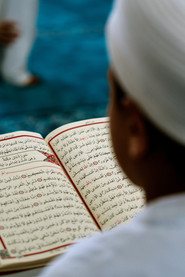
One has Arabic script on every page. Dense columns of text. Vowel marks above and below each letter. Small numbers marking each verse. The pages are thin. The binding is often green or black.
The other has English on one page and Arabic on the facing page. Or sometimes just English alone. The sentences flow like normal prose. There are footnotes, chapter introductions, thematic groupings.
Both are labeled "The Qur'an" on their covers.
Are they the same thing?
The short answer is: yes and no. And the longer answer matters more than most Muslims realize.
I used to treat them as interchangeable. The Mushaf sat on the high shelf — respected, wrapped in cloth, handled with care and wudu. The English translation sat on my nightstand — read casually, marked up with a pen, used for meaning.
I thought I was just using two formats of the same thing.
A scholar I later studied with gently corrected me. "They're not the same thing," she said. "One is the Qur'an. The other is a human's attempt to carry the Qur'an's meaning into English. Both are valuable. But they are categorically different. Confusing them leads to real misunderstandings — about the status of the text, about the limits of what translation can do, and about your own relationship with what Allah actually revealed."
That conversation reoriented my entire approach to both books.
What Is the Mushaf?
The Definition:
The Mushaf (مصحف) is the written compilation of the Quranic text in Arabic — the verbatim speech of Allah as it was revealed to the Prophet Muhammad (peace be upon him), transmitted through verified chains of transmission, compiled during the era of the companions, and preserved to the present day in exactly the form established under the caliphate of Uthman ibn Affan.
What "Mushaf" Technically Means:
The word mushaf (مصحف) refers to the physical written compilation — the pages bound together. The Qur'an itself is the speech of Allah; the Mushaf is the written recording of that speech.
This technical distinction matters because the Qur'an as the speech of Allah is not limited to the physical pages — it exists in the memories of the huffaz, in the recitation of every Muslim who recites it, in the transmission chains going back to the Prophet. The Mushaf is the written anchor of that living oral tradition.
What the Mushaf Contains:
Verbatim Arabic text — every word exactly as revealed. No additions. No subtractions. No paraphrase.
Vowel marks (tashkeel) — the small marks above and below letters that indicate how each word is pronounced, added by early scholars to protect pronunciation for non-Arabic speakers.
Verse numbering and surah divisions — organizational elements added to facilitate navigation.
Sometimes tajweed color-coding — color-coded systems indicating which tajweed rules apply where.
What the Mushaf Does NOT Contain:
Explanations. Context. Historical background. The reason a verse was revealed. What scholars have understood it to mean. Any human interpretation whatsoever.
The Mushaf is the text. Nothing more, nothing less.
The Status of the Mushaf in Sunni Islam:
The Mushaf is handled with specific adab (etiquette) rooted in Sunni scholarship:
Being in a state of wudu before touching it is the opinion of the majority of classical scholars
It is not placed on the floor or in undignified positions
It is stored in a high or honored place
It is treated as the physical container of Allah's speech
Dr. Ahmed told me: "The status Muslims give the Mushaf reflects their understanding of what it contains — not ink on paper, but the preserved speech of Allah. That understanding is not superstition. It's a theological position about the nature of the text. When a student understands this, the Mushaf stops being a book and starts being something genuinely different."
What Is a Quran Translation?
The Definition:
A Quran translation is a human scholar's attempt to render the meaning of the Quranic text into another language — in this context, English.
It is the translator's best understanding of what the Arabic says, expressed in the most accurate and clear English they can produce.
What a Translation Contains:
The translator's interpretation of each verse's meaning
English words chosen to approximate the Arabic meaning as closely as possible
Often: footnotes explaining context, historical background, scholarly interpretation of difficult passages
Often: surah introductions giving background to each chapter
Sometimes: the Arabic text alongside the English
What a Translation Is NOT:
The Qur'an itself.
This is the foundational point that must be understood clearly.
For a translation to do justice to the Quran and capture its elegance and vigor, it has to be accurate, smooth, eloquent, and accessible. Unlike most popular translations, The Clear Quran® Series masterfully passes on all counts. To achieve accuracy, the translator has made use of the greatest and most celebrated works of old and modern tafsir (Quran commentaries), and shared the work with several Imams in North America for feedback and insight.
Notice the framing: a translation does justice to the Qur'an. It captures its elegance. It approximates. These are the words of a translator who understands exactly what translation is — an attempt to carry meaning across a linguistic barrier, not a reproduction of the original.
Why Arabic Cannot Be Fully Translated:
Classical Islamic scholars have been unanimous on this point for fourteen centuries: the Qur'an is not translatable in the full sense. What can be translated is its meaning — and even that meaning is partial, because Arabic carries dimensions of meaning, grammatical connotations, rhetorical features, and poetic qualities that no other language can reproduce.
The word "Rahman" carries the sense of comprehensive, womb-like mercy. "Merciful" approximates it. But it doesn't carry the Arabic root's connection to the womb (rahm), to the cosmic scale of mercy encompassing all creation, to the specific connotations accumulated by this word through fourteen centuries of Quranic recitation. No English word does.
Every verse has dimensions like this. Translation carries the cargo of meaning across the ocean. But the ship is never the same as what it carries.
Fatima shared: "I grew up reading the Qur'an in English translation. I thought I knew the Qur'an. Then I began studying Arabic and started reading Al-Fatiha word by word in the original. I cried. Not because the translation was wrong — it was accurate. But because there was so much in the Arabic that the translation simply couldn't carry. 'Iyyaka na'budu' — 'You alone we worship' — captures the meaning. But the Arabic word order itself restricts the worship to Allah exclusively in a way that no English sentence order can replicate. The translation told me what it means. The Arabic showed me how it says it."
The Five Key Differences
Difference 1: Divine Speech vs. Human Interpretation
The Mushaf contains Allah's verbatim speech. Every word is exactly what was revealed. The recitation of the Mushaf is itself ibadah — worship.
A translation contains a human scholar's understanding of that speech. It is valuable scholarship. It is not Allah's speech.
The Prophet said: "Whoever reads one letter of the Book of Allah will have a reward, and that reward will be multiplied by ten." (Al-Tirmidhi)
This hadith refers to the Arabic letters of the Qur'an — the letters of the Mushaf. Reading an English translation is valuable and beneficial. But it is not the ibadah of Qur'anic recitation — the recitation that earns reward per letter.
Difference 2: Status in Worship
The Mushaf's Arabic text is what is recited in salah. Al-Fatiha must be recited in Arabic in every rak'ah — the English meaning cannot substitute for it. The Qur'an recited in prayers, in tajweed, in the specific Arabic form — this is non-negotiable.
A translation cannot be used as a substitute for Arabic in salah. It has no function in formal worship as a replacement for the original.
Difference 3: Handling and Etiquette
The Mushaf requires wudu for touching, according to the majority of classical scholars. It requires dignified handling and placement.
A translation does not carry the same legal rulings. A scholar can handle a translation without wudu. A translation can be annotated, marked up, written in. These things are not appropriate with the Mushaf.
Difference 4: What It Can and Cannot Do
The Mushaf gives you the exact words of Allah. Every letter. Every vowel. Every tajweed mark. The complete original.
A translation gives you the translator's best understanding of the meaning of those words. Scholars will sometimes disagree about the correct English rendering of a verse — because translation requires interpretation at every step.
Note: even the phrase "translated Mushaf" in common usage is technically imprecise. What is being described is a translation of the Qur'an alongside or instead of the Mushaf text — not the Mushaf itself translated, which is an impossibility.
Difference 5: The Question of Authority
If there is a disputed question about Islamic theology or practice, the Mushaf's Arabic text is the authoritative source. Scholars examine the Arabic — its grammar, its vocabulary, its rhetorical structure — to derive rulings and theological positions.
A translation cannot serve this function. A difference in translation is a difference in the translator's understanding — not evidence for an Islamic position. Two scholars can cite the same verse in two different English translations without either being an argument from the text itself.
Ahmed told me: "I've seen arguments in Islamic discussions where someone says 'but the translation says X.' That's not an argument from the Qur'an — it's an argument from one person's understanding of the Qur'an. The authority is the Arabic. Always the Arabic."
The Relationship: How They Work Together
Not Opposition — Collaboration:
Understanding the difference between Mushaf and translation is not an argument against using translations. Translations are enormously valuable. They're what allows Muslims who haven't yet learned Arabic to access the meaning of what they recite. They're a mercy — a bridge.
The right relationship is: use both, understand what each is, don't confuse them.
The Mushaf:
For recitation — daily recitation, salah, Ramadan recitation, everything that involves saying the Arabic words of Allah.
For tajweed practice — reading the vowel-marked text correctly.
For memorization — hifz from the Arabic.
For barakah — the specific rewards of Quranic recitation in Arabic.
The Translation:
For understanding — knowing what you're reciting.
For study — engaging with the meaning of verses intellectually.
For da'wah — sharing the Qur'an's message with people who don't read Arabic.
For motivation — deepening your connection to what you recite by understanding its meaning.
The Ideal Practice:
Recite the Arabic Mushaf. Then use the translation to understand what you recited. Then return to the Arabic with that understanding, letting the meaning deepen the experience of recitation.
Or study the translation alongside the Arabic — opening the Mushaf and the translation side by side, going verse by verse, experiencing both the sound of the original and the meaning carried across.
Zaynab shared: "My practice for years was: read the Arabic in salah, read the English in my own time. They lived in separate compartments. Then a teacher suggested: read the Arabic Mushaf for your daily wird, but open the translation first and read the meaning of what you're about to recite. Then recite the Arabic. The understanding enriched the recitation. The recitation deepened the understanding. Together they worked. Separated, each was incomplete."
What Madinah Media Offers: Both, Carefully Chosen
The Mushaf Selections:
Madinah Media carries multiple Mushaf editions — including the Uthmani Mushaf, Mushaf with tajweed color-coding, and other formats — each preserving the Arabic text in its complete, authoritative form.
Coloring Books · Children's Educational Series · Children's English Stories & Biography · Children's Prayers & Supplications · Quran/Mushaf · Mushaf Tajweed · Madinah Mushaf · Mushaf Uthmani · English Translation Quran · Digital Quran · Quran Learning · Tafseer · Arabic Learning
The distinction Madinah Media draws in their catalog — separate categories for "Quran/Mushaf" and "English Translation Quran" — reflects exactly the distinction this article makes. They're not the same category. They serve different functions.
The Translation Recommendation: The Clear Quran:
The Clear Quran® Series masterfully passes on all counts. To achieve accuracy, the translator has made use of the greatest and most celebrated works of old and modern tafsir (Quran commentaries), and shared the work with several Imams in North America for feedback and insight. For clarity, every effort has been made to select easy to understand words and phrases that reflect the beauty, flow, and power of the original text. Along with informative footnotes and surah (chapter) introductions, verses have been grouped and titled based on their themes for a better understanding of the chapters, their main concepts, and internal coherence.
The Clear Quran by Dr. Mustafa Khattab is Madinah Media's recommended translation — and one of the most carefully produced English Quran translations available.
Pleasant to read, easy to understand, and noted for its clarity, accuracy, eloquence, and flow. Approved by Al-Azhar and endorsed by Al-Furqaan Foundation and The Canadian Council of Imams.
The Credentials of the Translator:
Dr. Mustafa Khattab is a Canadian-Egyptian authority on interpreting the Quran. He was a member of the first team that translated the Ramadan night prayers (Tarawîḥ) live from the Sacred Mosque in Mecca and the Prophet's Mosque in Medina (2002-2005). Dr. Khattab memorized the entire Quran at a young age, and later obtained a professional ijâzah in the Ḥafṣ style of recitation with a chain of narrators going all the way to Prophet Muhammad (S). He received his Ph.D., M.A., and B.A. in Islamic Studies in English with Honors from Al-Azhar University's Faculty of Languages & Translation.
These credentials matter. A Quran translation produced by someone who memorized the entire Qur'an, holds an ijazah in Hafs 'an 'Asim with a chain to the Prophet, and holds advanced degrees from Al-Azhar specifically in Islamic Studies in English — this is a translation from inside the tradition, not from outside it looking in.
The combination of authentic scholarly grounding and modern English fluency is precisely what makes The Clear Quran a trustworthy translation tool — one that can be relied upon for meaning while the reader remains aware that it is a translation, not the Mushaf itself.
The Combined Edition:
Madinah Media carries The Clear Quran Series with Arabic Text — the Mushaf and the translation side by side. The Traceable Edition features Arabic text printed in light gray ink, offering a unique method for kids, students, and adults to memorize verses by tracing the gray with a pen.
Having both on the same page makes the correct relationship between them practical: the Arabic is primary, the English illuminates it, and they live together without being confused for each other.
Common Misconceptions to Correct
Misconception 1: "The translation IS the Qur'an"
The Qur'an is the Arabic speech of Allah. A translation is a human scholarly rendering of its meaning. They are categorically different. Treating them as identical misunderstands the nature of both.
Misconception 2: "Any translation is equally reliable"
Translations vary enormously in scholarly quality, theological reliability, and linguistic accuracy. Some contain significant errors. Some reflect specific theological agendas that affect rendering of certain verses. Choosing a translation from a qualified scholar with transparent methodology — like The Clear Quran — matters.
Misconception 3: "Understanding the translation means understanding the Qur'an"
Translation gives you access to meaning. But it doesn't give you the full meaning — Arabic's grammatical emphasis, word-order significance, rhetorical devices, and phonetic resonances are all partially or wholly inaccessible through translation. Understanding the translation is a beginning, not an arrival.
Misconception 4: "The Mushaf is too difficult to use — just use the translation"
The Mushaf's Arabic is what you recite. The relationship between Muslim and Mushaf — the daily recitation, the commitment to learning the language it's in — is itself an act of devotion. Using translation as a permanent replacement for engaging with the Arabic avoids the work that deepens the relationship.
Misconception 5: "The translation can be used in salah"
No position in mainstream Sunni scholarship permits English translation as a substitute for Arabic in salah. The Arabic of Al-Fatiha is the obligation. Understanding the Arabic through a translation is valuable; substituting it is not acceptable.
Ibrahim told me: "One of the most important things I teach new Muslims is: the English translation is your entry point, not your destination. It opens the door. Arabic is what's behind the door. As soon as you can, begin working toward the original. Use the translation as a companion on that journey — not as a substitute for making the journey."
Conclusion: Two Books, One Purpose
The Mushaf and the Quran translation are two different things serving one unified purpose: bringing Muslims into relationship with the speech of Allah.
The Mushaf carries the actual words — inimitable, preserved, the direct speech of the Creator.
The translation carries the meaning of those words — imperfect but valuable, a bridge across the language barrier.
Both belong in a Muslim home. Both belong in Islamic education. Both belong in your personal practice.
What belongs in your salah, your formal recitation, your hifz — is the Mushaf. The Arabic. The original.
What belongs in your study, your understanding, your engagement with meaning — is both. The Arabic deepened by the translation. The translation anchored by the Arabic.
Use them together. Understand them distinctly. Honor them both for what they are.
The Mushaf: Allah's speech, preserved in Arabic, the eternal original.
The translation: a scholar's best effort to carry that speech across into English — valuable, limited, always pointing back to the source.
Available at Madinah Media — both the Arabic Mushaf in multiple editions, and The Clear Quran translation by Dr. Mustafa Khattab, separately and in combined Arabic-English editions — for every stage of your Islamic learning journey.
Bismillah. Open both. Know which is which. Benefit from each.