
How Long Does It Take to Learn Quran?
A father messaged our community group on a Wednesday evening.
His daughter had just turned seven. He wanted to start her on Quran. He had been to three Islamic stores and looked at four curricula online. He was not confused about which book to buy.
He was confused about what he was even trying to accomplish.
"Does she need to read it? Memorize it? Understand it? All three? And how long does each one take? Nobody gives a straight answer."
That frustration is legitimate. And it is widespread.
"Learning Quran" is a phrase that covers at least three distinct things — and each of those things has its own timeline, its own method, and its own measure of success. Treating them as one question produces exactly the kind of confusion that father was experiencing.
This article separates them. Clearly. Honestly. With real timelines — not aspirational ones, not the timeline of the exceptional child prodigy, but the realistic timeline of an ordinary Muslim child or adult who starts, works consistently, and does not quit.
Every resource mentioned here is available through Madinah Media's Quran learning catalog. Every timeline is grounded in what teachers and parents working with these materials actually report. And every answer is given from within the Sunni understanding of what learning Quran is actually for.
First: The Three Things "Learning Quran" Actually Means
Before any timeline makes sense, we need to name what we are measuring.
The first is Quran reading. This means the ability to look at Arabic text and read it accurately — recognizing letters in all their positional forms, connecting them correctly, applying basic vowel sounds, and eventually reading continuously without stopping to decode individual letters. This is a mechanical skill. It does not require understanding the meaning. It does not require memorization. It is the ability to read.
The second is tajweed. This means reading the Quran correctly — with the specific rules of pronunciation, articulation, lengthening, and sound quality that the Prophet ﷺ used when he recited and that have been transmitted through an unbroken chain to the present day. Tajweed is not decoration. It is the authentic form of Quranic recitation. The Prophet ﷺ said: "Recite the Quran beautifully, smoothly, and precisely." The one who does so will be in the company of the noble angels. The rules that define "precisely" are the rules of tajweed.
The third is hifz. This means memorization — carrying the Quran by heart, so that it can be recited without the page in front of you. This is the most demanding and most honored form of Quran learning. It is what the Prophet ﷺ had. It is what his Companions had. It is what millions of Muslims across fourteen centuries have maintained.
Each of these three has a different timeline. And a parent who confuses them — who thinks their child needs to do all three simultaneously from the beginning — is setting up a journey that is harder than it needs to be.
Timeline One: Learning to Read Quran
The ability to read Quranic Arabic — to look at text and decode it accurately — is the foundation everything else rests on. Without it, neither tajweed nor hifz can be properly developed.
For a child starting from zero — no Arabic letters known, no familiarity with the script — the realistic timeline to fluent Quran reading is between six months and two years. The range is wide because the variables are significant: age, frequency of practice, quality of instruction, and whether the child has any existing Arabic exposure at home.
A child who practices every day for fifteen to twenty minutes with a qualified teacher or a structured workbook will progress faster than one who practices twice a week. A child who hears Arabic at home — in du'a, in salah, in conversation — has an auditory foundation that accelerates everything. A child who starts at five will learn differently than one who starts at eight or ten.
The benchmark is not a time period. It is a competency: the child can pick up a Mushaf and read any surah — even one they have never seen before — without stopping to puzzle out letters. When that is true, the reading stage is complete.
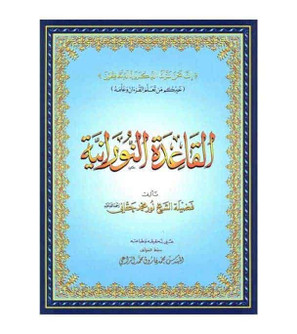
Al-Qaidah An-Noraniah by Sheikh Noor Mohammed Haqqani is one of the most widely used starting points for Quran reading — an authentic, structured method that teaches students how to read the Quran with tajweed in a beautiful and attractive way. It is available at Madinah Media and has been used by millions of children globally. Its sequencing — letters, vowels, combinations, connected text — is proven across generations and cultures.
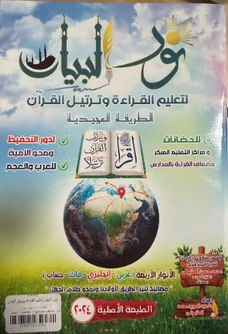
Nour Al Bayan is another excellent option for younger beginners — a step-by-step guide for teaching the Arabic alphabet and words that takes a child from their very first encounter with the script through the ability to read connected Quranic text. Both are available at Madinah Media.
The Safar Learn to Read Series: Complete Qaidah offers a different approach — the product of experienced teachers who have refined their method through years of classroom use. The Complete Qaidah specifically handles the Madinah script and builds reading competency systematically from the first page.
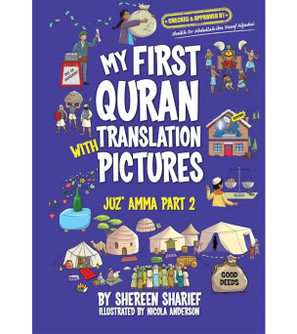
For children who are visual learners and need meaning alongside reading, My First Quran with Pictures: Juz' Amma (Parts 1 and 2) translates the simple meanings of Quranic verses into engaging illustrations — helping children visualize what they are reading while building basic reading fluency in Juz' 'Amma.
Umm Zayd, who homeschools four children and has taken each one through the reading stage with different resources, described what she has learned: "Every child needs the same fundamentals and a different pace. My eldest took fourteen months to reach real fluency. My second took eight. My third was almost two years because she has a different learning style and needed more visual support. The timeline that matters is not the average. It is the point at which your specific child can read without struggling. Everything before that point is preparation."
Timeline Two: Learning Tajweed
Tajweed is often misunderstood as an advanced subject — something you take up after you have been reading for years. This is backwards.
The best time to begin tajweed is at the same time as reading, or immediately after basic reading is established. The reason is simple: habits of mispronunciation that form in the reading stage become extremely difficult to undo. Memorizing at speed without tajweed produces fluent-sounding recitation that is full of small mispronunciations — each one locked into the student's memory and revised hundreds of times over the years, which is precisely why it is so hard to correct later.
Start correct. Correct from the beginning is always faster than relearning.
For the rules of tajweed — the theoretical knowledge of what each rule is, why it exists, and how to apply it — the realistic timeline for a motivated student working through a structured resource is six months to one year for the foundational rules. Mastery of the more advanced rules takes longer.
But theoretical knowledge of tajweed rules is not the same as applied tajweed — the automatic, consistent, unconscious application of those rules in real recitation. Applied tajweed takes years of practice to become natural. The rules have to be heard correctly, recited correctly, corrected by a qualified listener, and practiced hundreds of times before they become automatic.
Tajweed Rules of the Qur'an — a three-part series available at Madinah Media — acts as a comprehensive guide for non-Arabs studying tajweed in English. Part 1 covers articulation points, noon and meem sakinah rules, ghunnah, lam sakinah, mudood (lengthening), and the qalqalah mechanism. Part 2 covers letter characteristics, tafkheem and tarqeeq, and idghaam rules. Part 3 covers the rules of starting and stopping in recitation — what is permitted, what is forbidden, and what is preferred.
This is a complete theoretical framework. Working through all three parts seriously — with exercises, with examples, with a teacher to check application — gives a student the full rule set of tajweed.
Tajweed Untangled takes a different approach — a crystal-clear guide with plain-English explanations, practice exercises, and a layout designed to make what is sometimes considered a hard subject genuinely accessible. For students who find the three-part series technical, Tajweed Untangled is the entry point that removes the intimidation.
For children specifically, the Tajweed City Series by Hatim Suhaimat — a four-book set — teaches tajweed rules through an adventure story featuring a character named Zaid who travels through the world of letters, sounds, and articulation points. Zaid learns the characteristics, the letters, and the makharij through reading and coloring. It is designed for children seven and up and makes the science of tajweed feel like an exploration rather than a lesson.
For the classical foundation that scholars have used for centuries, Children's Bequest: The Art of Tajweed — based on the poem of Sulayman Al-Jamzuri written in the 12th century — gives serious students the foundational text of tajweed science, translated and presented in a teachable format. It has always been the most utilized text for teachers of tajweed, a testimony to its foremost standing among all resources for learning this science.
Ustadh Bilal, who has taught tajweed to both children and adults for over a decade, described the honest timeline: "Students who work with me twice a week, doing the exercises, practicing between sessions, and receiving consistent correction — they reach functional tajweed in about a year. By functional I mean they apply the rules consistently during recitation without thinking about them consciously. After that, we are refining and deepening. The first year builds the system. Every year after that makes it more beautiful."
Timeline Three: Memorizing the Quran
Hifz is the most beloved form of Quran learning in the Islamic tradition. It is also the one most surrounded by unrealistic expectations.
The Quran contains 114 surahs, 6,236 ayahs, and approximately 77,000 words across 30 juz'. Memorizing it completely — with correct tajweed, with the ability to recite any part on request — is an achievement that the Islamic tradition honors with specific rewards in this life and the next.
The realistic timeline varies significantly by age, method, and intensity.
A child who begins memorization at age five or six, working one ayah at a time every day, reviewing consistently, and continuing through the school years — such a child can realistically complete the Quran between ages twelve and fifteen. A structured program takes children from six to twelve through the Quran at a pace of four juz' in the first year, then five juz' per year for the following five years — completing the entire Quran with solid memorization and correct tajweed in six years, with approximately one hour of daily study plus one hour of review.
That pace requires daily commitment and qualified guidance. It is ambitious but achievable. The key word is daily.
An adult beginner who has never memorized before — who starts Hifz at age twenty-five or thirty — is not starting from zero. They have adult cognitive advantages: stronger ability to understand what they are memorizing, better study discipline, clearer motivation. What they lack is the child's neuroplasticity — the effortless encoding that makes childhood memorization seem to happen almost automatically.
An adult who memorizes three ayahs per day, reviews consistently, and maintains the work through revision — such a person can complete the Quran in approximately three to five years. The range is wide because adult life creates more disruptions to consistency than childhood does.
The most important fact about hifz timelines is this: the timeline is not the point.
The Prophet ﷺ said: "The one who recites the Quran and is proficient in it will be in the company of the noble and righteous scribes. And the one who recites the Quran and finds it difficult, and stutters through it — they will have a double reward." The reward is not proportional to speed. It is proportional to sincerity, effort, and quality.
A child who memorizes slowly but accurately and who understands what they are memorizing carries more than a child who races through hifz with weak tajweed and no understanding. A parent who remembers this will not pressure a child to hit milestones that serve the parent's pride rather than the child's development.
The Noor Al-Quran series from Madinah Media — the most comprehensive integrated Quran curriculum available, used in Islamic schools globally — is built around exactly this understanding. It integrates memorization with tajweed, vocabulary, meaning, and values from the earliest levels. A child who works through Noor Al-Quran is not just memorizing. They are building the complete relationship with the text that makes memorization lasting and meaningful.
For families working through Juz' 'Amma specifically — the thirty surahs most commonly memorized first — the Al-Qaidah An-Noorania: Juz' Amma with Surat Al-Fatiha from Madinah Media provides a color-coded tajweed edition of the most commonly memorized portion of the Quran. The color coding makes tajweed application visual and immediate — a tool that dramatically accelerates both reading accuracy and memorization quality in the early stages.
Fatima, a mother who has guided three children through various stages of Quran learning, offered the most grounded perspective: "Stop asking how long it takes. Start asking whether your child is moving. Movement is the point. One ayah memorized today is one more than yesterday. A reading session that produces one corrected letter is a session that mattered. The parents who ruin hifz are the ones who turn it into a race. The parents who produce real huffaz are the ones who turned it into a rhythm — a daily practice that is just part of how the family lives."
What the Timeline Actually Depends On
The honest answer to "how long does it take to learn Quran?" is: it depends on four things.
Consistency. Nothing replaces daily practice. A child who reads fifteen minutes every day will outperform a child who reads ninety minutes twice a week. The brain learns through repetition across time — not through volume in a single session. Daily contact with the Quran is the non-negotiable.
Quality of instruction. Tajweed cannot be self-taught in isolation. The ear has to hear correct recitation from a qualified source and the mouth has to be corrected by someone who knows what correct sounds like. The resources available through Madinah Media provide the structured foundation. A qualified teacher — live or through audio — provides the corrective feedback that no book alone can replace.
Starting age. Children who begin before age eight have genuine neurological advantages in language acquisition. The earlier, the more effortless. This is not a reason for anxiety in parents of older children — adults can and do achieve full hifz. It is a reason to begin as early as reasonably possible.
The right resources for the right stage. A resource too advanced produces frustration. A resource too simple produces boredom. Madinah Media's Quran Learning catalog — organized by stage, age, and objective — removes the guesswork from matching the resource to the learner.
The Answer
To the father who messaged his community group on a Wednesday evening — the one whose daughter had just turned seven — here is the direct answer.
Reading fluency: six months to two years of daily practice. Start with Al-Qaidah An-Noraniah or the Safar Complete Qaidah.
Tajweed: the foundational rules in one year of consistent work, applied correctly over the years that follow. Start with Tajweed Untangled or the Tajweed Rules of the Qur'an series. Add Tajweed City for your daughter's age.
Memorization: Juz' 'Amma in two to three years of daily sessions at her age. The complete Quran in six to ten years of sustained, consistent effort with qualified guidance. Start with the Noor Al-Quran series and the Juz' Amma with color-coded tajweed.
Do not ask how long it takes. Ask whether you have started. Ask whether you are consistent. Ask whether the resource matches where she actually is.
Everything else takes care of itself.
Bismillah. Start tomorrow morning